How to prepare for an AI interview without sounding robotic
AI interviews reward clear evidence, not polished robot talk. Learn how to practice, tell real stories, and stay natural when software is part of the process.
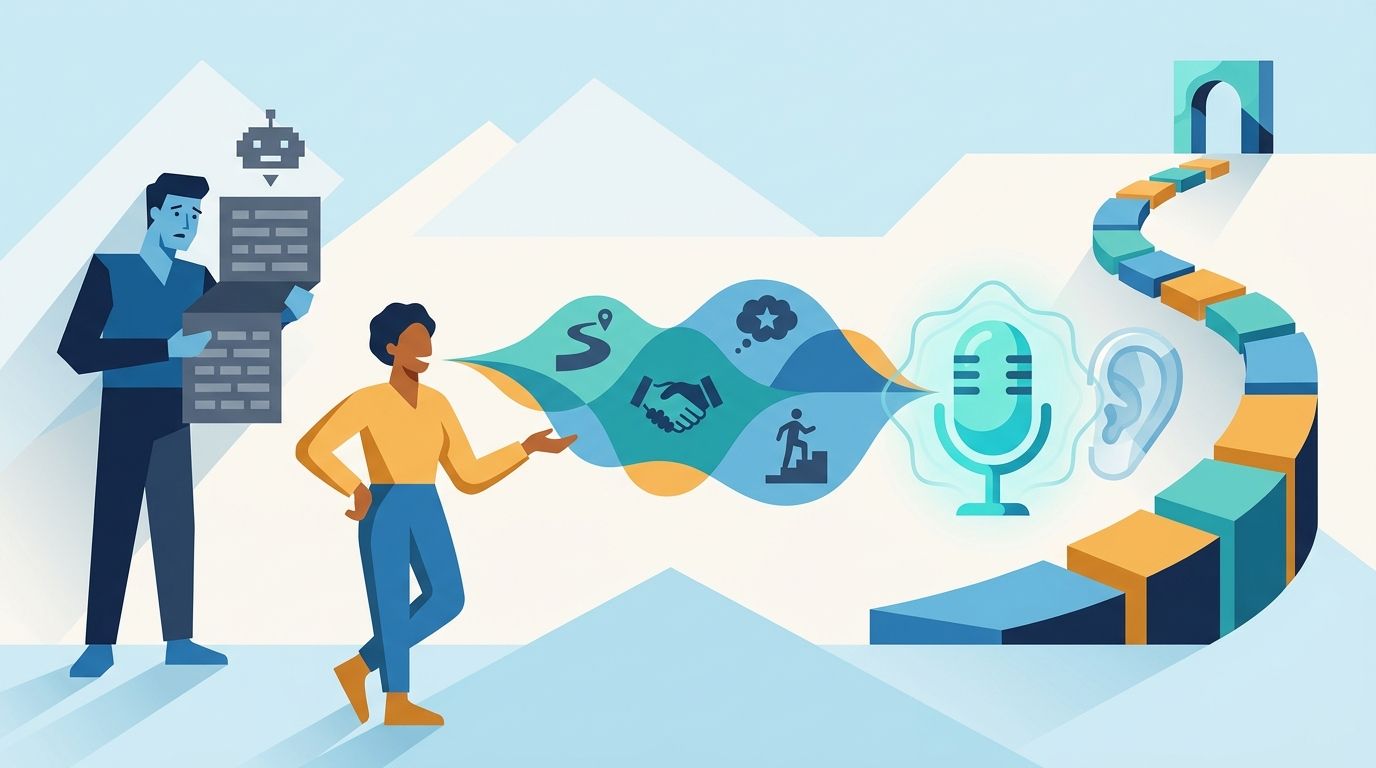
The laptop camera is on, your coffee has gone cold, and a question appears on screen: "Tell us about a time you solved a difficult problem." You've practiced the answer so many times it no longer sounds like you. That is the trap. To prepare for an AI interview, you need structure without memorization, clear evidence without buzzwords, and enough practice to stay present when the technology feels unfamiliar.
An AI interview may record your spoken answers, present questions through software, transcribe what you say, or help a hiring team review responses. Some tools support a live interviewer. Others create an early screening step. The safest approach is the same regardless: answer the actual question, use specific proof, and speak like a thoughtful person rather than a résumé read aloud.
CNBC recently reported on the growing use of AI interview technology and what job seekers should know before they meet it. The tools are changing, but the useful preparation is not. You still need to understand the role, choose honest examples, and explain how you work.

Know what an AI interview can and cannot do
Before you practice, find out what kind of interview you have. "AI interview" is a broad label. It can mean an automated video screen, a text chat, a recorded response platform, or software that helps a recruiter organize interview notes. Those experiences ask different things from you.
Read the invitation closely. Look for details about:
- Whether you answer by video, audio, typed text, or live conversation
- Whether you get practice questions before the real interview
- How much preparation time you have for each response
- Whether you can redo an answer
- Who to contact if the technology fails
Don't assume the software is judging your personality from every blink or hand movement. Companies use different systems, and many tools focus on the words you provide, the questions you answer, and the work evidence you share. Still, you should not treat an automated interview as casual. Your response may become part of a hiring record.
The Equal Employment Opportunity Commission has warned that automated hiring tools can create discrimination risks, especially when a system evaluates people with disabilities or relies on measures unrelated to job performance. That doesn't tell you exactly how one employer's tool works. It does give you a useful principle: focus on job-relevant evidence, and ask for a reasonable accommodation if the format creates a disability-related barrier.
If you need an accommodation, contact the employer before the interview. You can write, "I am looking forward to the interview. I would like to request an accommodation related to the interview format. Could you tell me whom I should contact to arrange this?" You do not need to disclose more medical information than necessary.
The goal is not to beat a mysterious algorithm. It is to make your work easier for a person, a transcript, or both to understand.
Build a small story bank instead of memorizing scripts
Robotic answers usually start as over-prepared ones. You write a perfect paragraph, memorize every sentence, then lose your place when the question shifts slightly. A story bank works better. It gives you facts to draw from without forcing you to perform a speech.
Choose four or five moments from your work, school, volunteer activity, military service, caregiving, or job search. Each moment should show something the target role actually needs. You do not need a dramatic rescue story. A useful example might involve fixing a recurring error, calming an upset customer, learning a system quickly, or making a decision with incomplete information.
For each story, write short notes under these prompts:
- What was happening?
- What did you personally do?
- What changed because of your actions?
- What did you learn or do differently later?
Take Jordan, a support specialist in Columbus, Ohio. Jordan is applying for a customer success role. One story involves a billing issue that hit several small-business customers at once. Jordan noticed the help center article was giving the wrong instruction, flagged the pattern to the billing team, helped update the article, and tracked support tickets for the next month. The result was not a heroic sales number. It was a cleaner process and fewer repeated questions. Honestly, that kind of unglamorous fix is exactly what hiring managers remember.
Jordan can use that story for questions about customer empathy, problem solving, cross-team work, or process improvement. The facts stay the same. The emphasis shifts with the question. That flexibility keeps the answer natural.
You can also prepare one story for each common interview theme:
- A mistake and what you changed afterward
- A conflict or disagreement handled with care
- A project completed under a tight deadline
- A skill you learned without much direction
- A result you can explain with a number or visible outcome
Keep your notes in plain language. "Reduced ticket volume by 18 percent over four weeks" is stronger than "optimized the customer experience." If you do not know the exact number, say what you do know. "The team stopped receiving daily duplicate reports" is honest and specific enough.
Answer with a simple shape, not a speech
A strong answer has a beginning, a middle, and an ending. You do not need to announce a framework or recite labels. Just give the listener a path through the event.
Start with the situation in one or two sentences. Explain the problem or goal. Then spend most of your time on your own actions. Close with the result and a short reflection.
This shape is close to the STAR method, which stands for situation, task, action, and result. The method has lasted because it helps you answer behavioral questions with evidence. The danger comes when you turn it into a rigid template and force every answer into the same rhythm.
Priya learned this during a recorded interview for an operations coordinator position in Raleigh. Her first answer began, "In my previous role, I demonstrated exceptional cross-functional leadership by leveraging proactive stakeholder communication." It sounded polished. It also said almost nothing.
She tried again: "At a warehouse in Raleigh, orders were sitting in three different spreadsheets. I compared the lists, found that two teams were using different cutoff times, and built one shared schedule. The team had fewer missed handoffs the next week. I would use the same approach here: find where the process splits, then make the next action visible."
The second answer is not less professional. It is easier to trust because the listener can picture the work.
Before you answer, ask yourself:
- What is the real point of this story?
- Which action belongs to me?
- What evidence can I name?
- Why does this matter for the role?
Aim for about 60 to 120 seconds unless the platform gives a different limit. A short answer can be complete. A long answer can still be vague. If you need a pause, take one. "Let me think of the clearest example" sounds more human than a rush of filler words.
Remove buzzwords without flattening your expertise
You do not need to avoid professional language completely. You need to connect it to something observable. Words like "strategic," "collaborative," and "results-driven" go soft when they stand alone. They become useful when you show what they looked like in your actual work.
Try this conversion:
- "I am a strong communicator" becomes "I wrote a one-page handoff guide so the afternoon team could resolve the same issue without calling me."
- "I thrive under pressure" becomes "When two team members were out, I sorted requests by deadline, told customers what would change, and closed the urgent queue before Friday."
- "I am highly analytical" becomes "I compared six weeks of order data and found that most delays started after one manual approval step."
Marcus is preparing for a data analyst interview in Phoenix. He has a habit of listing every tool he has used before explaining what he actually found. When asked about a project, he rattles through SQL, Excel, Tableau, Python, and several internal systems, and the listener has to wait too long for the point.
So Marcus changes the order. He starts with the business question, explains the data he used, names the tool only when it matters, and gives the result. "The service team wanted to know why callbacks were rising. I joined call records with account data, found that one product change was confusing new customers, and built a dashboard the team could check by week." Now the tools support the story instead of replacing it.
You can check your own language with a simple test: could someone outside your field repeat the main point after hearing it once? If not, replace one abstract phrase with an action, object, or result.
This matters even more when an interview platform creates a transcript. Specific nouns and verbs are easier to parse than a cloud of polished phrases. Say what you changed, who used it, what happened next, and what you would carry into the new role.
Practice for the technology, not just the questions
Good practice includes the room around you. A strong answer can fall apart when your microphone is muted, the browser blocks camera access, or the platform gives you 30 seconds to prepare and nothing more. Run a short technical check before the real session.
Test these details:
- Your camera, microphone, headphones, and internet connection
- The interview link in the browser the employer recommends
- The lighting and background behind you
- Whether the platform records a practice answer
- A backup plan if your connection drops
Keep a phone number or email for the recruiter nearby. If the system fails, document what happened and contact the employer promptly. A technology problem is not a character flaw, although it can feel like one while your laptop displays the spinning wheel of doom.
Then practice in conditions that resemble the real interview. Record three answers on your phone. Watch or listen once, but do not judge your face. Look for practical signals:
- Did you answer the question in the first 15 seconds?
- Did you use a real example?
- Did you explain your own actions?
- Did you stop when the answer was complete?
- Could someone understand your words without seeing your résumé?
Use one practice round with no notes. Use another with three keywords nearby. If you need a brief outline during the real interview, write prompts like "problem, action, result," not a full script. Full scripts pull your attention away from the question.
You can also practice with someone who knows nothing about your field. Ask them to repeat what they think you did. If they remember the tool but not the problem, revise the answer. If they remember the result but not your role, make your actions clearer.
Updraft's free interview-readiness check lets you submit one spoken or typed interview answer for grounded feedback and a practical next step. It does not assess your overall job-search readiness or predict whether you will be hired. You can try it at https://app.updraft.careers/start. Further practice depends on your Free or Pro allowance.
Stay natural when the question feels strange
An automated interview can make ordinary questions feel loaded. You may wonder whether a pause looks bad, whether glancing away will hurt you, or whether the system expects a particular phrase. That anxiety often causes people to speed up and give answers with no texture.
Slow down enough to actually understand the question. If it asks about a conflict, do not answer with a teamwork story that contains no real disagreement. If it asks about a failure, do not disguise a success as a failure. A real mistake with a clear correction is more credible than a manufactured weakness.
Suppose the prompt asks, "Tell us about a time you received difficult feedback." You could say: "At a nonprofit in Milwaukee, my manager told me that my weekly reports were accurate but hard to scan. I had buried the decision points under too much background. I asked for two examples, moved the key numbers to the top, and added a short recommendation section. The next reports took less time to review, and I still use that structure whenever a reader needs to make a quick call."
That answer has a human detail, a real flaw, and a concrete change. It does not pretend feedback felt pleasant. It shows you can use it.
If you lose your place, restart plainly. "I want to answer that with a better example." Then continue. If a question is unclear, ask whether you may have it repeated. If the format does not allow that, answer the part you understand and name your assumption out loud.
You are allowed to sound like a person. A little warmth helps. So does a sentence that is not perfectly polished. The goal is not to imitate a machine that never searches for a word, it is to make your judgment visible.
Use the final minute to connect your answer to the role
Many candidates prepare strong stories and forget the handoff to the job. The interviewer should not have to guess why your example matters. Add one sentence that connects the experience to the work you want to do.
This does not mean repeating the job description back. It means naming the relevant pattern. "That experience would help me manage competing client requests here because I learned to make priorities visible before the queue became urgent." That is a connection. "I am excited to leverage my transferable skill set in this dynamic environment" is not.
Before the interview, review the posting and pick out three needs the employer repeats or emphasizes. They might include:
- Managing a high volume of customer requests
- Explaining technical information to nontechnical people
- Building reliable processes from incomplete information
- Working independently while keeping others informed
Match each need to one story. Then prepare two questions for the end of a live interview or for a written follow-up. Ask about the first 90 days, the team's current challenge, or how the company measures success in the role. Specific questions show that you are evaluating the job too.
After the interview, write down the questions you received while you still remember them. Note which examples landed and where you rambled. If the employer invites another round, improve one answer rather than rewriting everything. Small changes are easier to carry into the next conversation.
Your preparation should leave you with a calm plan: a few true stories, a short outline, a tested setup, and questions that help you decide whether the role fits. That is enough. You do not need to become a flawless speaker just because software is sitting between you and the hiring team.
FAQ
What should I say in an AI interview?
Answer the question with a specific example from your work, education, volunteer experience, or another relevant setting. Explain the situation, your actions, the result, and what the experience taught you. Use plain language and avoid claims you cannot support.
Can an AI interviewer tell if I am nervous?
The answer depends on the employer's technology and how it is configured. Do not assume that facial movement, eye contact, or a nervous pause tells the whole story. Focus on clear, job-related evidence, and request an accommodation if the format creates a disability-related barrier.
How long should an AI interview answer be?
Aim for about 60 to 120 seconds for a behavioral question unless the platform gives another limit. A complete short answer is better than a long answer with repeated context. Stop once you have explained the result and its relevance to the role.
Should I memorize my interview answers?
No. Memorize the facts and the order of your story, not every sentence. A few keywords can help you stay oriented while leaving room to respond naturally to the exact question.
How can I practice for an AI interview?
Record answers to common questions, check your microphone and camera, and listen for vague language or missing results. Ask someone outside your field to explain what they understood. You can also use Updraft's free interview-readiness check for grounded feedback on one spoken or typed answer.
Your next step can take ten minutes. Choose one real work story, write four notes about what happened and what you did, then record a 90-second answer on your phone. Listen once. Replace one vague phrase with a concrete action. That small edit moves you closer to sounding prepared, not robotic.
Join the conversation
Subscribe to comment
Join Updraft's newsletter to leave a comment and get new posts in your inbox.